

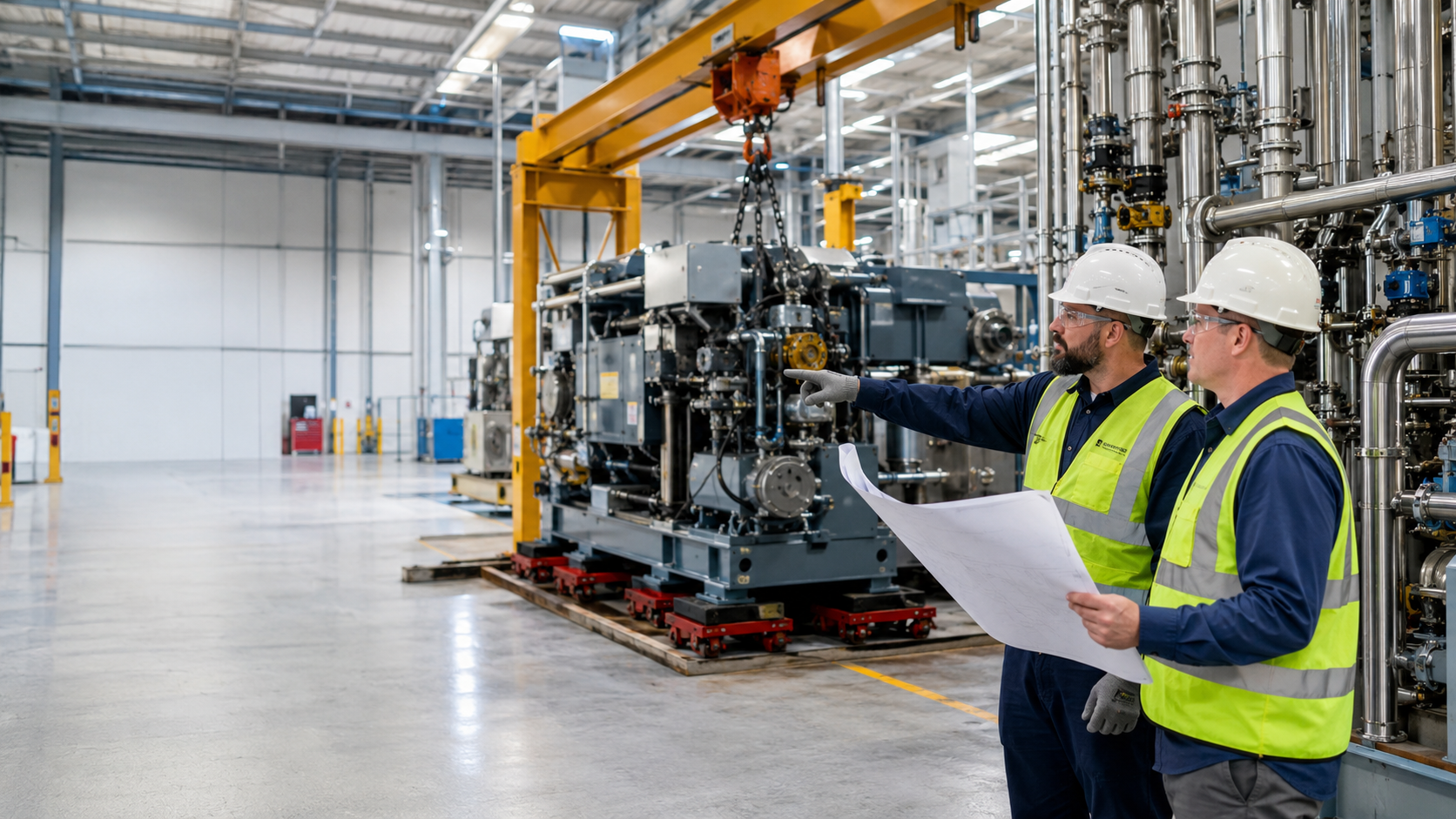
Relocating industrial equipment is rarely just a move from one footprint to another. A successful relocation may involve rigging, access planning, foundations, electrical and controls coordination, process piping, compressed air, drains, ventilation, startup, and a tightly managed production schedule. If any one of those pieces is missed, the project can create avoidable downtime or delay the return to normal operation.
For plant managers, maintenance leaders, project engineers, and general contractors, a written relocation checklist helps turn a complex move into a coordinated installation plan. The objective is to protect people and production while making sure the equipment can be set, connected, tested, and restarted as intended.
Survey the current and future locations first
Start with a field survey of both the existing equipment location and the destination. Confirm machine dimensions, weight, center of gravity, approved pick points, anchoring details, utility connections, and clearance requirements. Then trace the route between the two locations from the delivery or staging point through the final set location.
Look beyond the machine footprint. Door openings, ceiling height, overhead obstructions, floor transitions, live production areas, pedestrian routes, and access for forklifts or lifting equipment can all affect the move. Early field verification gives the team time to adjust the sequence or staging plan before a shutdown window begins.
Define the rigging and movement plan
Rigging scope should be evaluated before equipment is disconnected, not after it is ready to move. Coordinate with an experienced industrial rigging team to review equipment weights, lifting points, travel paths, floor loading, machine skates, crane or forklift requirements, and safe staging areas. The team should understand what needs to be moved, where it must go, and how the work interacts with the plant’s normal operations.
A practical rigging plan also identifies access controls, communication needs, temporary removals, and any support required from facility personnel. This helps prevent the common situation where equipment is ready to move but the route, lift equipment, or work area is not.
Coordinate utilities and mechanical disconnects
Before the move, identify every service connected to the equipment. Depending on the process, that may include electrical power, controls, process piping, compressed air, water, drains, ventilation, lubrication, gas, or other utilities. Each connection should have an assigned owner, an isolation approach, and a plan for safe disconnect, protection, and reconnection.
Process piping deserves particular attention because new routing, elevation, supports, valves, and tie-in locations can affect both installation and future maintenance. A qualified process-piping contractor can help define the piping scope before the relocation window, including materials, access, isolation, testing, and any required prefabricated assemblies.
Prepare the destination for installation
The destination should be ready before the equipment reaches it. Verify foundations, housekeeping pads, embeds, anchors, equipment clearances, drainage, access, and required structural supports. Coordinate mechanical work with electrical, controls, HVAC, fire protection, building trades, and the operations team so that conflicts are resolved before installation begins.
When the relocation is part of a larger expansion or reconfiguration, industrial construction coordination helps align setting, utility installation, piping, supports, and startup activities under a workable sequence. That is especially valuable when adjacent production must remain online.
Plan the shutdown, tie-ins, and restart together
Equipment relocation often includes a limited outage window. Treat that period as a controlled production event: define the work sequence, lockout and isolation responsibilities, materials staging, testing requirements, decision points, and contingency steps if conditions change. Complete as much surveying, fabrication, and staging as practical before the shutdown so the field team can focus on the work that must occur while equipment or utilities are unavailable.
Restart should be included in the original scope, not left to the final hour. Assign responsibility for mechanical completion, utility verification, testing, punch-list items, operator handoff, and cleanup. This gives operations a clear path from a relocated machine to a production-ready asset.
Industrial equipment relocation checklist
- Verify the equipment’s dimensions, weight, center of gravity, pick points, and final footprint.
- Survey the route, staging area, final location, clearances, and floor/loading conditions.
- Define rigging equipment, movement method, access controls, and work-area requirements.
- Identify every utility connection and assign disconnect/reconnect responsibilities.
- Plan new or modified process piping, supports, valves, tie-ins, testing, and access.
- Confirm the destination is ready for foundations, anchors, drainage, utilities, and adjacent trades.
- Document the shutdown sequence, contingency plan, startup tasks, and turnover responsibilities.
A well-defined scope helps the project team move with more confidence and fewer surprises. If you are preparing to relocate or replace industrial equipment, contact Midsouth Mechanical to discuss rigging, process-piping, installation, and restart planning before the production window is set.